Showing posts with label Experimental Cinema. Show all posts

The Project: Clocks [2007]


[New Avant-Garde Movement Project]

[intro] | [films]


**** 

CLOCKS
(John Philippe Carpio, Philippines, 2007) - 11'07''


****
DESCRIPTION 
[from his vimeo]

"
* 2007
* Color
* Dance
* Mini DV
* TRT: 11:06 minutes

The film was edited from a documentation of a dance performance collaboration between Donna Miranda, Dancing Wounded Contemporary Dance Commune and other independent artists entitled "PROMISES ARE MADE TO BE BROKEN", it was performed on two separate evenings in 2006 (November 9 and 11) at the Lumiere Café and Gallery along Makati Avenue. The long dance piece involved rehearsed and improvised sections as well as unrehearsed collaborations with the different audience members on each night.

"CLOCKS' is one portion of the entire piece.

CHOREOGRAPHY: Donna Miranda, Red Lasam, Dancing Wounded, Tess Jamias, Diego Maranan *PERFORMERS: Donna Miranda and Red Lasam *ALSO FEATURING: May Bayot, Jose Jay B. Cruz, Tess Jamias and Diego Maranan *PRODUCER, EDITOR, CAMERA OPERATOR: JP V. Carpio *PRODUCTION AND STAGE MANAGER: Issa Lopez *STILLS: Jed Escueta

a linao films and dancing wounded production

The film is part of an ongoing series of documentation work involving the Dancing Wounded Contemporary Dance Commune.

For screening and DVD copy requests please e-mail linaofilms@gmail.com

Festival Screenings:

Uncensored Bodies Film Program, Wi_fi Body 2: 2nd Independent Contemporary Dance Festival, July 2007

Indiemand V Film Festival, UP Pi Omicron Fraternity, University of the Philippines Diliman, 5 December 2008"


*****

The Project: Dung-Aw [1990]


[New Avant-Garde Movement Project]

[intro] | [films]


****

Dung-Aw
(Mario Guzman, Philippines, 1990) - 4'13''


****
DESCRIPTION 
[from his yt]

"Dung-aw (Lament), 16mm. experimental short film on children of war produced by Goethe Institut was awarded Best Experimental Film, 1990 Gawad Urian (Filipino Film Critics Award) and 1st Place Experimental Film Category, 1990 CCP Gawad Para sa Alternatibong Pelikula at Video (Cultural Center of the Philippines' Award for Alternative Film and Video)."


*****

The Project: A White Balloon [2011]


[New Avant-Garde Movement Project]

[intro] | [films]


****

A White Balloon
(Nick Block, USA, 2011) - 5'52''


****
DESCRIPTION 
[from his vimeo]

"For Jafar Panahi and Mohammad Rasoulof 
Credits: Actress: Nicole Cano 
Editing: Darius Darque 
Grip: Juan Flores"


*****

The Project: Estratto Matrimonio [2011]


[New Avant-Garde Movement Project]

[intro] | [films]


****

 Estratto Matrimonio 
(Ilaria Pezone, Italy, 2011) - 12'30''


****
DESCRIPTION 
[from her vimeo]

"Shooting and editing." 


*****

The Project: Homo Sapiens Project (I) [2011]


[New Avant-Garde Movement Project]

[intro] | [films]


****

Homo Sapiens Project (I)
(Rouzbeh Rashidi, Ireland, 2011) - 7'43''


****
DESCRIPTION 
[from his vimeo]

"Homo Sapiens Project is an ongoing series of personal video works by Rouzbeh Rashidi initiated in August 2011 for both online and screen context. They are highly experimental, part cryptic film diaries and part impressionistic portraits of places and people, and often suffused with an eerie sense of mystery reminiscent of horror cinema. From highly composed and distantly framed meditations to frenetically flickering plunges into the textural substance of moving images, the restless creativity of this vision of life as a cinematic laboratory is never short of surprising. Encompassing everything from documentary monologues to found footage, Rashidi constantly strives to expand his filmmaking palette while putting his unmistakeable stamp on whatever footage passes through his hands." [for more info]


*****

The Project: Desinence II [2012]


[New Avant-Garde Movement Project]

[intro] | [films]


****

Desinence II
(Carlo Labrador-Pangalangan, USA/Philippines, 2012) - 15'00''


****
DESCRIPTION 
[from his vimeo]

"No description."


*****

The Project: The Island [2011]


[New Avant-Garde Movement Project]

[intro] | [films]


****
The Island 
(Fred. L'Epee, Switzerland/Greece, 2011) - 5'00''


****
DESCRIPTION 
[from his vimeo]

"Form:  
A - Distance
B - Memory
C - Exile 
The distance is a perpetual geometry wich controlling our way of life and perception of our cogitation. In response, we create the movement. 
Through this movement, we use the memory into our psycho- affective system in the purpose to imagine our freedom, our cries, our drifts, our social struggles, our exile. In exile, all we are. 
We belong to this path. And we use it as an ultimate form of being. The Ideal is definitely established.  
 The waves always emerges in us..."


*****

The Project: Lesser#3 Meditation No. 3 [2011]


[New Avant-Garde Movement Project]

[intro] | [films]


****

 Lesser#3 Meditation No. 3 
(T.C. Chew, US, 2011) - 5'17''


****
DESCRIPTION 
[from his vimeo]

"this is another page in my research journal for project title: Lesser#3.

it does not contain conventional artistic and commercial distribution value.

it is produced merely for the expression & eventual annihilation of the self.

please forgive our trespassing of the worldly dogmas & possessions which, with all respect, some of us hold onto so dearly.

the montage engineers wish to thank all the brothers & sisters of humanity who have contributed directly and/or indirectly to the evolution of the images and sounds in this video.

borrowing the ideas from 1000 plateaus (Deleuze & Guattari), we like to say that in lesser#3 meditations, there is no beginning and ending, just becoming...

omg, i'm sounding so seriously already. where's the joker when u need one? my thoughts are flowing again, meditation number four coming soon. hehe.."

*****

Film of the Day: Drux Flux [2008]

[photo credits to NFB site]
[video credits to NFB youtube channel]

DRUX FLUX [2008]
Theodore Ushev

animation
Avant-garde/Abstraction
4 min 47 sec


Is there such a word to describe Drux Flux? I'll say this firmly: unfortunately, there is none.

Such animations like this almost attempt to discredit the definition of animation language: that the language assumes a representation of something. It seeks to break away from this definition and isolate itself from the wholeness of animation theory, into a fractured depiction of a new universe. If animation theory might help us with other types of animation such as cell animation, an approximate to live-action features, and marionette animation, a close to theatre art, there is a possibility that Drux Flux does need its brevity and thoroughness to exist.

Drux Flux resists this genre-enclosed categorical limitations and forms a new language, a new visual semiotic in serious fashion. To answer the question, why is Drux Flux so different from Spirited Away (2001) and Tardi drawing entails a careful remark of what form it assumes. This inquiry is filled with bearings: As to what style it is accustomed? How much accountable images can we draw? Is it still a form of animation or documentary?

After watching Drux Flux the second time around, i formed some intense thoughts:


 Post-Modernism and Avant-Gardism


Two compatible fields of thought, two modern trends in art which can elucidate and decipher the richness of the animation in Drux Flux. Post-modernism is such a high word to describe a piece of art, and it must entail a certain care and vigilance when using it One thing about post-modernism that strives to be defined: 'intertexuality'. Intertexuality it can be seen as a thought that rejects the existence of a 'grand all-encompassing idea' (technically called meta-narratives) to explain truths, to acknowledge a point and to support reason. Jean-Francois Lyotard propose intertexuality and recognize the importance of local narratives. This local narratives are not only broken down but significantly dependent on each other.

This skepticism on the 'universalised' ideals is connected to the rise of the Avant-Garde movement in cinema some decades ago. Avant-Garde is a group skeptical with the mainstream culture and arts. They form new types of art through experimentation and usually innovative efforts. They are the 'extremists' of arts that denies the norms and pushes the limits of their creativity to new heights. Postmodernism may have fueled this sudden rise in avant-garde films.

Drux Flux works this way. It is an animation of a postmodern thought. Notice how equivalent the drawings of the 'mechanical man', which will comprise a part of our discussion on the later part of the text, to the anatomy drawings of Leonardo Da Vinci. It exists with reference to other 'texts.' The usage of photographed buildings and other derivative works such as cardboard arts and grafitti denotes DRUX FLUX's supreme dependence on them. If the animator takes away the photographs, the Da Vinci-like drawings, the cardboard images, Drux Flux cannot function as a whole. It needs the presence of these elements, hence it defineds its 'truthfulness' as text through the use of other texts. It carries a title, therfore, a Postmodern animation.

Aside from its usage of other texts to define its exclusivity as an art form, it attempts to dislodge itself from the current trends using a bizarre visual and graphic almost a structureless expositions. it molds a peculiar style of animation, highly contestable and rarely manifested in mainstream domains. It is the product of series of experimentation with photography and cell animation, hence a form of Avant-Garde animation. But this is clearly not the first one to attempt such style. The overlapping of images, and eccentric graphic approach rather than filmic has been a standard for avant-garde animation artists since the 1920s.


Ciao!
*****

Oms and other Fantastic Creatures in René Laloux's Fantastic Planet (1973)

I have this strange attraction to weird cinema.

RenĂ© Laloux's Fantastic Planet (1973) is  a different kind of experience. It feels like cut-out from H.P. Lovecraft's stories. It treats absurdity as the new norm. Perhaps, strangely, the gravity of art in RenĂ© Laloux's film may be too demanding for ordinary cinephiles, but its use of anthropomorphic imagery to represent different creatures makes it a familiar film. One can compare it to several post-apocalyptic films where worlds are invaded by aliens of higher intelligence. The Oms (the humans) were treated as slaves and pets by Draags (the aliens) which set them to become rebels --- a racial issue.


Laloux's world is filled with magical and uncanny elements. Draags are giants and are attune to meditation by achieving a spiritual connection with the cosmos. Oms are much smaller, about the size of the thumb of Draags but are irritable and biting. The Draag communities are, of course, real world counterparts of the evolved communities which has level of intelligence  (let us say scientific intelligence) far superior than less developed communities. 


In a Draag's world, there is no snow but there are crystal storms which can turn any living non-Draag creature into crystals unless the creature knows how to whistle.

Ohm's mass extermination via a heavy, toxic gas is largely due to Draag's immediate response to the Ohm's extremely large and increasing population. Ohm's ratio to the population versus a Draag is that of the ants' population to the humans. The gas can kill Ohms instantly like how insect spray can kill thousands of ants. 


Ohms are used as hunting 'dogs' chained by their master Draags to look for other Ohms.


Laloux's creatures are filled with uncanny spirit. This one looks like an elephant with nine protruding nostrils.


This elephant creatures eat a "fly"-looking creature with certain mimicry to Frill-necked lizards in Australia but fatter.


Gigantic creatures, relative to the Ohms, have at least four legs and an elongated body. But this one, it has more than five eyes on top. Its morphology is quite unique.


Other than gigantic creatures, Ohms too have creature the size of their body.  This creature on top are used for Ohm to Ohm battle.


As with this one above, they are used to create Ohm's clothes. They are perhaps the most harmless of all fantastic creatures in Fantastic Planet. 


Creatures can also fill large voids of land as with this long and winding worm-like creature.


 Ohm's most notorious antagonist is a creature with wings that of a bat. It has four legs and long tongue to suck Ohms our of their borrows. Though their viciousness can be equal to that of the Draags, its aim is only predatory and not exploitative. Hence, this creature is innocent. 

Laloux's creatures shows us another version of human life, and that is by using uncanny figures to elicit unworldliness. This uncanny mechanism has long been used in experimental and animated films. It shows us strangely familiar figures functioning differently, absurdly.

Ciao!
*****


Film of the Day: Inhabitants [1970]; John Torres' Lukas Nino


Inhabitants (Artavazd Peleshian, 1970)


*****


H.E.L.P


follow here


A repost from John: 
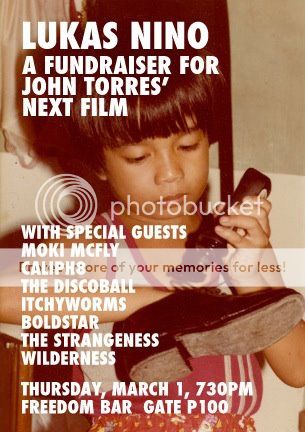
Hi guys! I’m working on the DVD release of my Otros Trilogy shorts, and a boxed set of my three features: Todo Todo Teros, Years, and Ang Ninanais, as part of my effort to raise funds for my next film, tentatively titled, Lukas nino. 
Lukas nino got a Digital Production grant from the Hubert Bals Fund, but since part of the film will be shot on 35mm film, I need funds to cover film stock, processing, and transfer. 
Starting Thursday, March 1, you can pre-order signed copies of my DVDs and boxed sets, posters, tickets to the premiere of Lukas nino, and a book I'm releasing later this year. 
But by coming on Thursday, you are already helping out. 
LUKAS NINO: A fundraiser for John Torres' next film. 
Freedom Bar, Anonas Thursday, 
March 1, 730pm 
With guest performances by Itchyworms, Boldstar, Caliph8, Moki McFly, Discoball, Wilderness, The Strangeness.
Also screening 'Synthetic Substitution', a selection of short films curated by Merv Espina 
Gate: P100, comes with a free drink;


Ciao!
*****

Women in Film

...

A Portrait of Ga (Margaret Tait, 1955, United Kingdom)


 Semiotics of the Kitchen (Martha Rosler, 1975)


Ciao!
*****

La Libertad (Lisandro Alonso, 2001)

or when contemplation is itself a political and aesthetic statement...


...

The heaviness of the cinematic medium in terms of political and aesthetic content have undoubtedly changed the way we watch films. Consciously, we form expectations through our experiences. And the predictability-unpredictability of a certain approach in filmmaking remains, for many, the fundamental premise for our understanding of a certain film. This result to numerous familiar stratagems we see in today's commercial and art cinema. It is, by its nature, the reason why art films can be formulaic as much as genre films can be. The polemics of the approach is very much like what Godard and Truffaut did in the French Cinema of the 60s. Of course it starts with independence and the glorification of the auteur. From then on, art films have managed to create its own stylistic system often with supreme antagonistic insight about the commercial cinema. But some also favored the half-way house wherein commercial cinema and art cinema meets. That house, once a small part of art cinema, is now a booming genre with an increasing market value and a sizable audience turning itself into a pseudo-commercial cinema (which often denies itself from being one).

Abstraction has never been this good. Most of Cannes Film Festival films sells good. Lars Von Trier sells artsy mutilation films (of course with a Criterion label) while Pasolini's Salo, or 120 Days of Sodom (1975) is a cult. We get a glimpse of how controversy and issues on censorship can stir the sales to heights one can never even imagine. This is the kind of politics Lisandro Alonso and a pack of filmmakers like Lav Diaz and Raya Martin attempt to disarm.

Films like La Libertad (2001) disconnects us from this new cultural hegemony of pseudo-commercial films and takes us to the center of cinema itself: the persistence of vision in twenty-four frames per second. La Libertad brushes through a man's life as if it was a painting from a lost time. Like still life paintings of Cezanne, the film can be 'hanged' on walls of one's house and let it breathe through that space connecting volumes of emotions. It is through this method, the manifestation of La Libertad as some sort of a moving painting, that cinema has triumphed in resuscitating itself.

Banality, in this case, is a form counterculture and a form of abstraction. The film strikes a phenomenal glare on what is happening in today's cinema, which, if not manipulative to the audience often robbing the democracy of one's eyes and one's own thoughts to see and think through the film. La Libertad liberates the viewers from this unconscious hegemony of the frames and refreshes what is cinema in their eyes. The lack of narrative drive and polemics of the film depoliticized and de-clog the overload sign-symbol systems of the contemporary cinema. It narrates plainly a day in a life of an Argentine woodcutter. The story unfolds without deviations from the main narrative and nothing happens. No causal interactions between the characters, no drive and definitely no motivation.

The film achieves total radicalism from today's cinema. Far from the capitalist-infested commercial cinema, far from the overloaded art cinema, far from the cult films, there lies a small portion of cinema where it takes us to its core and even to its origin: the persistence of vision, the moving image, and the simplicity of depiction of an event like the  Arrival of a Train (1896).

Ciao!
*****


The Mechanics of Love (1955)

by Willard Mass and Ben Moore


Erosion of emotions. 


You can watch the whole film here. Download it here.

Ciao!
******