Showing posts with label Neoformalist. Show all posts

TWELVE GIFTS TO CINEMA

...twelve essays on twelve memorable film experiences this year...


Dearest readers, I welcome you all to another year-end special of AUDITOIRE: Twelve Gifts to Cinema! In the spirit of Christmas, Auditoire has written twelve film essays celebrating another year of a memorable encounter with cinema. This year's top 12 films were carefully chosen from a pool of 100+ films watched by Auditoire from January 1, 2010 to December 25, 2010. The twelve films are historically variant chosen from different eras possessing different styles and different approach to filmmaking. This is to introduce the readers to variety and heterogeneity of cinema in form and style and to produce detailed essays to guide each film enthusiast in the aesthetic and thematic issues of each film. The series will begin tomorrow and end until January 2011.

TWELVE GIFTS TO CINEMA

1 |

2 |

3 |

4 |

5 |

6 |

7 |

8 |

9 |

10 |

11 |


12 |


Merry Christmas and a Happy New Year!


Ciao!
****


"But...

...Thompson is hardly an anarchist. Her analysis is systematic, following her critical assumption that films are systematically unified, with devices on a variety of levels (narrative, stylistic, and ideological) subordinated to an organizing "dominant". It is her sense of these interrelations that make Thompson impatient with easy satisfaction of interpretation."
--- Tom Gunning on Kristin Thompson's Breaking the Glass Armor: Neoformalist Film Analysis. (Film Quarterly, Vol. 43, No. 3 (Spring, 1990) pp. 52-54) (here)


Ciao!
***

Still reading it, hope to make my own one for December, probably on Tokyo Story (1953), Children of Paradise (1945), La Grande Illusion (1937), Seven Samurai (1953), and
Breathless
(1960), Serbis (2008), and tsadaaan... 2012 (Emmerich, 2009).

Flexibility of Neoformalist approach is highly intriguing. I love it! But it needs to be tested like many other theory.


Ciao2x!


***

University of the Philippines - Film Institute (UPFI) has a new website, at last! I have been waiting for this like about one year ago. Applause! Applause! Applause! [here!]

Perhaps the most unexpected cinematic adventure i had this week, apart from some good old porn classics and Rolland Emmerich's bombastic 2012 (2009) which most of my friends like, was Manila (Martin and Alix, 2009) [here, here, and here], the almost five-hour contemplative epic Now Showing (Martin, 2008) [here, Ogg's here, Alexis' here, Harry's here, Cahiers' here, and here], and the In Memoriam: Alexis Tioseco specials: John Giavato's Profit Motive and the Whispering Wind (2007), and A Candle (For Alexis and Nika) (2009), and Bontoc Eulogy (Fuentes, 1995). I am not surprised mainly because of their aesthetics but the superlative reason of watching all films at UPFI Cine Adarna and the Videoteque almost alone. It is somehow not a rewarding experience at all.

Saturday last week I was pumped up on watching Emmerich's 2012 with friends, and the Trinoma cinema was full, the audiences were shrieking, kicking and gasping altogether, such a wonderful experience on a very ordinary film! However, upon watching Now Showing at UPFI's Videoteque, I watched it alone in a cold, dark room, and I am sad that I am alone, why am I alone watching a big film, an important film by Raya Martin, why? Though I prefer to watch DVDs in my dorm room alone, I can never ever forget watching such a film in a small video room in solitude! Have all people gone on strike! Where did all the people go! Where oh where! Cinema, for me, died on that day, November 18 of 2009, on that room! I killed myself right after that by eating a piece of meat (of course, you must know that I don't eat meat at all for about six months now!). ;-(

Ciao! T.T


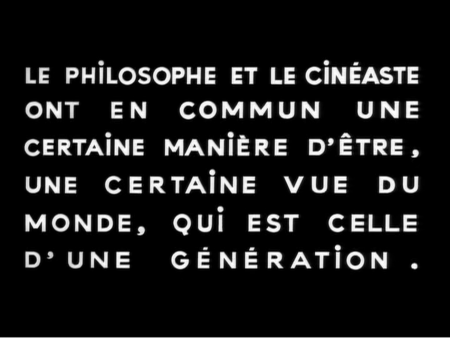
Socialisme, Godard and Victor Scklovsky

...perhaps art for art's sake, but more than that...

[Godard intertitles from]


Socialisme (Jean-Luc Godard, 2009) - art for art's sake - (via P)

I am lively reading my future life in the film world, the reason why i re-created this blog: Kristin Thompson's Breaking The Glass Armor. It launched me way up to the top of my dream. I finally have in my hands, over a cup of coffee, a copy of the book that will hold the foundation of my approach to films, the Neoformalist approach.

And here is what strikes me the most, from Russian Formalist, Victor Scklovsky, re-quoting from Kristin Thompson:

"If we start to examine the general laws of perception, we see that as the perception becomes habitual, it becomes automatic. . . Such habituation explains the principles by which, in ordinary speech, we leave phrases unfinished and words half expressed. . . The object, perceived in the manner of prose perception, fades and does not leave even the first impression; ultimately even the essence of what it was is forgotten. . . Habituation devours work, clothes, furniture, one's wife, and the fear of war. . . And Art exists that one may recover the sensation of life; exists to make one feel things, to make the stone stony. The purpose of art is to impart the sensation of things as they are perceived, and not as they are known. The techniques of art is to make objects 'unfamiliar,' to make forms difficult, to increase the difficulty and length of perception because the process of perception is an aesthetic end in itself and must be prolonged."

--- (From Victor Scklovsky's "Art as Technique" from Russian Formalist Criticism: Four Essays.)


De Sade it is.


SOS....


952 8 () VET


Le Philosophe. |---|


Ciao!
****